
Published by California Dating Guide
Why Bay Area distance is more than mileage
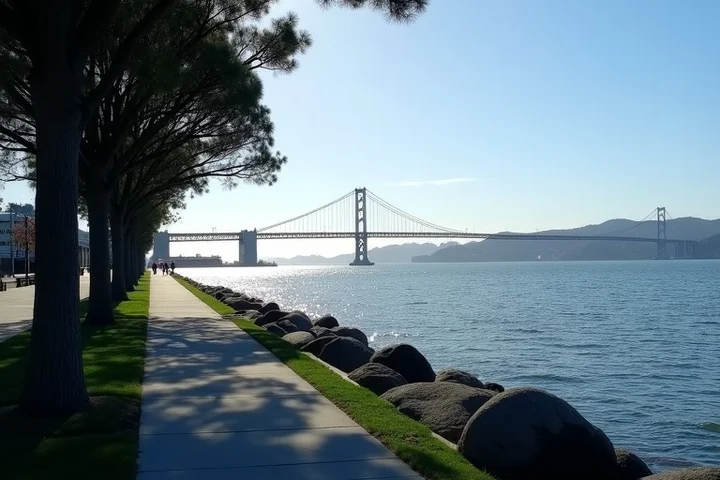
In the San Francisco Bay Area, map distance is a poor test of dating logistics. Water crossings, bridge traffic, the direction of a commute, station access, transfers, parking, and the final trip home can turn a short-looking route into a long evening. A person leaving Oakland after work and a person leaving San Francisco after work may face a very different burden than the map suggests.
Use door-to-door time instead: leaving work or home, reaching the meeting area, getting back afterward, and being functional the next morning. That matters especially on weeknights, when a pleasant date can become difficult if one person must leave early to protect a long return trip or cannot rely on a late transit connection.
BART is a regional rail system serving the Bay Area, so a plan near a useful station can reduce some cross-Bay friction. But a station-to-station trip is not the whole date: account for the walk, bus connection, ride share, or drive at each end. Similarly, Caltrain can make San Francisco–Peninsula–San Jose plans more practical for people whose homes and schedules align with that corridor, without making every South Bay plan equally easy.
Bay Area Rapid Transit — official information · Caltrain — official information
Map the routine each person can realistically sustain
Before deciding that distance is either manageable or impossible, compare the routine you would actually use. Do this for the usual weeknight meeting time and for a weekend window; the answer may be different.
- Start and end points. Name each home neighborhood and usual work location. A person based near Lake Merritt may have a different practical route than someone farther into the East Bay, just as a person in the Mission District may have a different return than someone on the far side of San Francisco.
- Usual transport. Say whether each of you normally drives, uses transit, bikes to a station, or needs a ride share for the last leg. Do not assume that a geographically central location is equally reachable by both methods.
- Real return limit. Identify the latest time each person can reasonably leave without creating a stressful trip home, an expensive fallback, or a next-day problem. This is more useful than agreeing vaguely to meet “after work.”
- Available date windows. Compare which weeknights are truly open, how often either person can host, and whether weekends allow enough time to justify a longer cross-region visit.
- Repeatability. Try one ordinary weeknight plan and one weekend plan. If either plan requires unusual energy, perfect traffic, or one person repeatedly sacrificing sleep, treat that as a limitation of the routine rather than a one-off inconvenience.
Choose a meeting territory before defaulting to one side
Choose the meeting territory from the harder route, not from a map midpoint or the more familiar neighborhood. If both people can reach a transit-linked commercial district with similar effort, use that as early neutral territory. For an Oakland–San Francisco pairing, a place with straightforward access to each person’s transit route may be more sustainable than routinely asking one person to cross the Bay and then make another local connection.
Alternate home regions when both routes are broadly comparable. That can mean one date in San Francisco, the next in the East Bay, with each person choosing an area that keeps the other person’s arrival and return realistic. Downtown Berkeley can work better than a deeper East Bay destination when it removes a difficult last leg; the right choice depends on where each person begins and how they travel.
Meet near one person only when the route difficulty is genuinely uneven and the arrangement recognizes that. For example, if one person has a simple direct trip while the other faces multiple transfers or a long late drive, meeting closer to the harder route can be fairer than alternating locations by habit. Reserve farther plans, including trips involving the Peninsula or Downtown San Jose, for weekends or longer date windows instead of forcing them into short weeknights.
Building reciprocity into the travel pattern
Reciprocity means neither person becomes the default traveler, planner, or late-night commuter. It does not require each date to be mathematically identical; it requires the overall pattern to acknowledge the real inconvenience.
- Agree on the default rhythm. Set a starting pattern that matches your routes, such as a transit-linked weeknight meeting and a longer visit on alternating weekends. Make the pattern specific enough that neither person has to renegotiate every plan.
- Alternate the burden that actually matters. If travel time is similar, alternate sides of the Bay. If it is not, balance another part of the plan: the person with the easier trip can travel more often, choose and book the plan, cover the inconvenient time slot, or host when hosting is possible.
- Handle hosting as a separate constraint. Do not promise alternating overnight or at-home plans if roommates, family, work schedules, pets, or housing rules make that unrealistic. Build the routine around the hosting options you actually have rather than treating unavailable hosting as a lack of effort.
- Check same-day conditions before a fixed plan. For driving or transit-dependent dates, check current road conditions, service advisories, and return options before committing to a narrow schedule. When the route is disrupted, choose a closer meeting territory or move the longer plan rather than expecting one person to absorb the disruption.
Test the arrangement in ordinary life
After a few dates, assess the pattern rather than the chemistry of a single unusually good or difficult night. The arrangement is promising when both people can propose repeat plans, get there and home without recurring resentment, and stay connected between visits without every conversation becoming travel coordination.
Revise the territory or timing when the same person repeatedly makes the longer crossing, leaves early, pays for the fallback trip, or loses an entire evening to transit and traffic. If a realistic weeknight plan does not exist, a weekend-focused rhythm may still work. If neither person can sustain even that rhythm without disproportionate effort, the logistics are uneven enough to name directly before the relationship depends on a routine neither person can keep.
Where the factual details come from
- Bay Area Rapid Transit — official information — Bay Area Rapid Transit
- Golden Gate Bridge, Highway and Transportation District — official information — Golden Gate Bridge, Highway and Transportation District
- Caltrain — official information — Caltrain